BLOG

Scrapbooks Are A Deja View: How Mine Saved My HS Reunion

By Laurie Einstein Koszuta and Kent Paar

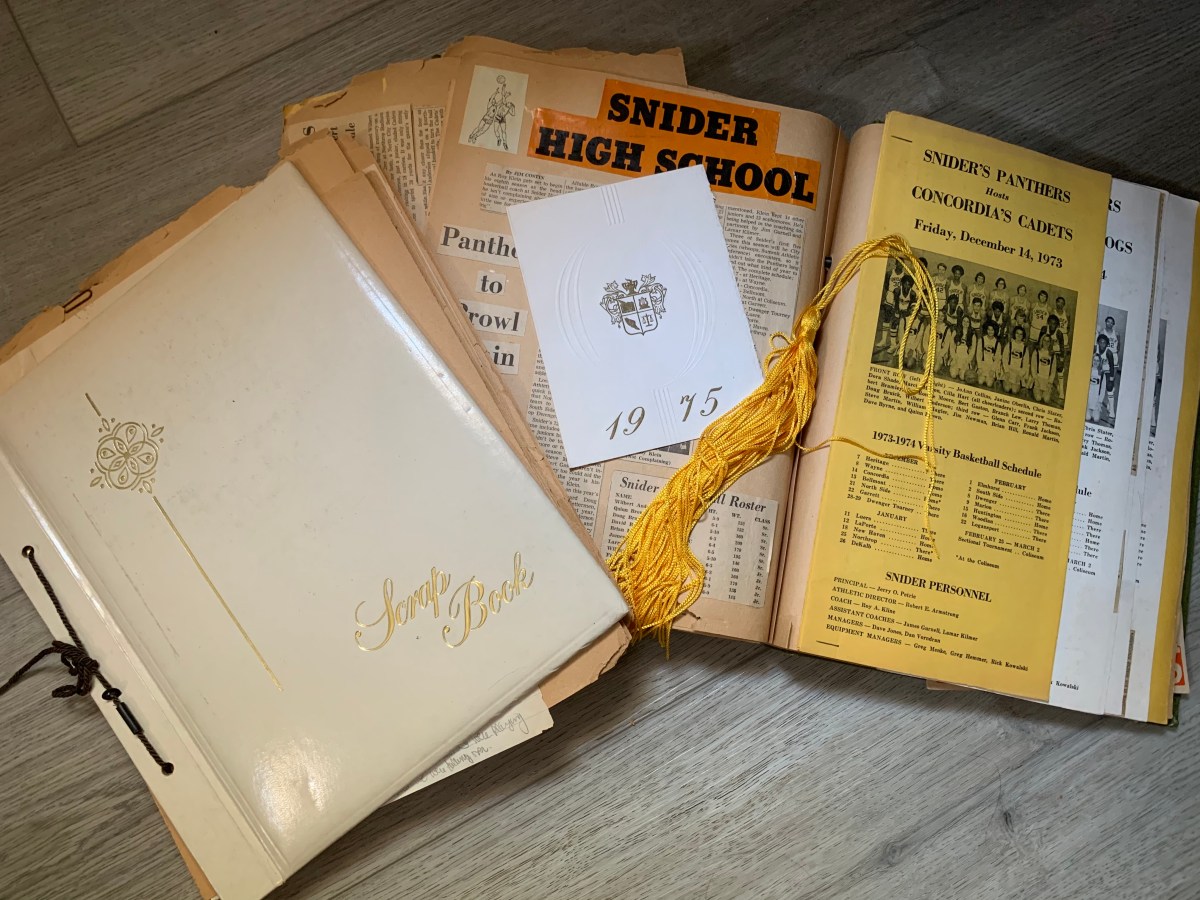
I am Laurie, and I had a scrapbook, and because I did, I found a friend. Scrapbooks can do that. The pages were just old high school memories from another era, now all faded and brown, tattered and torn and worth nothing to anyone but me. Or so I thought. But then, COVID-19, with its shelter-in-place orders heard around the world, changed everything. While others were cleaning baseboards and binging on Netflix, I wanted more than fluff, and something made me think of that 45-year-old scrapbook of teenage memories I had put together long ago.

I finally located it, stashed in a closet, under items that should have been discarded long ago. The scrapbook itself probably should have been thrown away with all the other seemingly useless things, but something had always held me back. I probably kept it for a rainy day. COVID was no rainy day, but it did give me an idea. 

My high school class of 1975 had been planning a reunion in late 2020. And, as it happened, I was leading the charge for the event. Like so many other planned gatherings, the coronavirus forced us to cancel. But what was once teenage nostalgia possibly might make the same people, now adults, laugh, smile and reminisce. It was so apparent to me. What would happen if I photographed all the items in my scrapbook, categorized them into grade levels and posted the pictures on our private, closed Facebook page? 

As it turns out, a lot can happen. 

I am Kent and I am that friend that Laurie found and one of the classmates who saw those posts. I was really touched by her scrapbook. She first posted one picture and another the next day and the day after that until she was posting pictures regularly. They seemed to follow a pattern of academics, sports, the arts, music and community involvement. I found myself looking forward to the near-daily postings. Like everyone else, I was trying to figure out how to keep busy while being home because of COVID-19. 

Our class Facebook group of over 120 people seemed to come alive as a result of those posts. The strange thing is that Laurie and I didn’t know each other very well during high school. We had a huge graduating class of 504 students. I was startled at how each successive scrapbook post brought back long-forgotten memories, not just for me but for the many classmates who responded. I found myself nodding “yes!” to comments from classmates I didn’t even know or remember. 

One of the first posts was the playbill from ‘Sugar,’ our staged high school musical. I was in the “Sugar” pit orchestra, where I played the trombone. With just a few photos and a few decades of age under my belt, I recalled many talented classmates and their varied roles in that fun production. All of us were carrying teenage baggage and stress, so putting on a production of that size required excellent herding skills from the fine arts faculty. I recalled those things, but perhaps it was more amazing to read that my classmates felt the same way. We were loving these posts and it seemed that we couldn’t get enough.  

Laurie’s Turn: With each passing day, I too looked forward to posting something new from my scrapbook, things that had not been seen in decades. Some posts garnered no comments or very few simply because no one remembered the subject matter. “What banquet?” said one commenter about a post. “Did we have a banquet?” which clearly told the entire story. And some posts obviously made classmates search inward and respond. “I was more about pleasing others than myself,” noted one classmate, “but you wouldn’t accuse me of that behavior now.”

Kent’s Turn: The sports memorabilia that was posted made me recall just how proud I was of our teams and our classmates. In one post, I remembered how proud I was that the basketball team competed on a historic basketball court in our town with our school’s name emblazoned across their jerseys.   

Then there was the post about the winning state track championship, a pretty big event for the school and the town. Unfortunately, my memory of that event was clouded by getting into a fender bender during a celebratory car caravan. The car ahead of me had minor fender damage, but I totaled my sister’s junker after borrowing it without asking her permission. Those photos brought up all kinds of memories!

Laurie’s Turn: The comments on those posts were interesting, reflective and were both positive and negative. “I wish I didn’t remember the yellow walls of the hallway,” noted a classmate, “now it just looks so 70’s.” “I’ve forgotten so many chapters of my life,” wrote a classmate in one post, “school experiences leave an indelible imprint on many of us.” “This stuff is gold,” noted another. 

Kent’s Turn: But a scrapbook like this and it’s magic doesn’t always bring old classmates together. Some don’t want to look back, avoid these gatherings, ignore invitations to a class Facebook page and want to be left alone. Maybe looking back is too painful and the past is best left behind. That’s okay. An important lesson learned. 

The thing about scrapbooks, and yearbooks too, is that they are usually neat and tidy and filled with smiley “gosh-how-nutty-was that” photos. They report on happy and remarkable past events and achievements. In fact, we know that life doesn’t always play out the polished yearbook or scrapbook way. It certainly didn’t back in high school and it doesn’t now. 

Laurie’s Turn: But for many, when the last entries were posted, there was disappointment echoed by many classmates. The memories that had sparked a lot of discussion had come to an end. But it really wasn’t the end. The angst of those teenage years was obviously gone, but it was evident from the weeks of posting photos of high school memorabilia that my classmates wanted to remember. They tried to rekindle old friendships, forge new ones and reminisce for a few minutes.

It was a simple scrapbook I made years ago. Still, because of a canceled reunion and a worldwide pandemic, the miles between friends narrowed. It was the connections that counted and still do. 

Inside Story: Coronavirus

It might seem like the coronavirus is nearing an end. I wish it were. If I judged simply by the reaction of the public, it does seem to be waning. However, my reality is different, as the virus is still front and center in my life. No, I don’t have the virus and never have had it, but if it were a thing of the past, I would not still be visiting my parents through a window of their assisted living facility. The doors are still locked and nothing much has changed in three months since the pandemic seemed to erupt. The fact is that nothing much seems to be changing for the elderly population in this COVID world. 

I understand the reasoning behind keeping the doors locked to visitors, mainly since the elderly are such a vulnerable population. I am keenly aware of all the horrible nursing home outbreaks and deaths and the various surges and spikes that are being reported. It goes without saying that we need to keep the elderly safe, but we need some communication as to where we are going with this. As dramatic as it sounds, I am just not confident that the doors will be open to visitors again in the foreseeable future. 

With that in mind, I had to review my own situation with my elderly parents. My 94-year-old father was languishing alone in a senior living apartment, in a downhill spiral of utter depression. My 96-year-old mother was already in assisted living, having lived apart from my father for more than two years. Married 69 years and used to visiting for a few hours every day, the coronavirus kept my parents separated for about eight weeks. If there was any hope of them seeing each other alive again, I decided to move my father to the assisted living facility. It was imperative for their emotional health even with a fourteen-day quarantine looming overhead and knowing that they could not come out of the facility for a long time. 

Moving for anyone can be a huge hassle, but moving a 94-year-old out of an apartment filled with memorabilia and comfort items is even more stressful. Add the coronavirus restrictions and the result can be devastating. 

When we were finally able to get everything arranged, we hired a couple of strong guys with a truck. We dismantled my father’s one-bedroom apartment as quickly as we could get things packed. The movers wore masks, gloves and entered and exited through the back door to get to their truck. It seemed like an elaborate undercover government operation as we finished without causing too much-unwanted attention.  

The movers were not allowed in the building once they arrived and were required to leave the furniture and boxes at the front door. It was up to one family member to take it from there. Although the facility maintenance worker helped a bit, overall, it was up to one person to figure out how to quickly get everything set up. As soon as my father was moved in, he was left to adjust to his new surroundings without further help from us. Then, they both faced a fourteen-day quarantine since my father had come in from the outside.  Thankfully, their room was close enough to an outside courtyard area, and they were allowed to sit outside for a few minutes a day to get some fresh air. 

I am well aware that even though facilities try to be accommodating to family members, their hands are tied because of state regulations. Facilities will be the last in any planned phased opening so the doors will remain locked for visitors. It is frustrating because there does not seem to be an end in sight. It has even been said that these facilities won’t open to visitors until January 2021 or even later, perhaps not until there is a vaccine. If that is the case, then it seems like these facilities are just warehouses for old people. That sounds harsh and it is.

The elderly are weary, depressed and their lack of understanding of the situation is taking a toll on them. Some family members don’t even visit through the glass as visiting makes their loved ones even more upset. The confinement and constant threat of a fourteen-day quarantine make family members like me cancel necessary out-of-facility doctor and healthcare visits. While telehealth is the next option for the elderly, it is not the same. And of course, since in-facility beauty shops are not open, even the length of their hair makes their patience run thin. 

 I am weary too. It has been a long three months of navigating elder care in this age of COVID-19. Window visits have lost their luster and frankly, like everyone else, I have coronavirus fatigue as it has gone on so long. I know I have to be an adult with this and not whine. I try to explain that things will get better even if I have no clue if they actually will and no matter how tired I am of this situation. As my parents’ age into their mid-90s, they occasionally mention the burden of all this on me. No one ever would have imagined that the end of their lives would look like this. 

The frustration for visitors is also the disparity between who is allowed into the facilities as an essential person. Phone repairmen who have been all over are allowed in but not family, off-duty staff members and potential new employees can go in but again not family. Vendors can come in and so can visiting nurses and therapists. As regulations evolve, workers must undergo mandatory testing every two weeks. 

So where do we go from here? Even if assisted living facilities and nursing homes start plans to go into a phased opening for visitors, it seems certain that it won’t be the easy in and out that it used to be. Will there be routine yet mandatory temperature readings and testing for visitors? Will visitors have to show proof of antibodies, negative test results or vaccine? Could visits be limited not only in the length of time in the facility but how often you are allowed to visit? And finally, will these new measures significantly increase the already high cost of facilities?

Of course, no one knows the answers to these particular questions and even though I am frustrated and worn out, I do wish there was more communication of what the near future might look like. So I will continue to trudge through the dirt, dust and shrubs and stand in the summer heat to get to the window until there is a better solution.

Jest For Success

Let’s face it; the world is in turmoil, and it might seem like there isn’t anything funny to think or talk about. But that isn’t true. Comic relief is all around us, just waiting in the wings. Have you seen the pictures online of people wearing shoes, coffee filters, old compact discs, diapers, or duct tape as face masks? Of course, these things don’t work, but the laughs they provide are priceless. 

There is no doubt that hard times can bring out the darkest of humor. Everyone knows that the coronavirus isn’t funny, and neither are its symptoms or effects. However, it is how we deal with what is left, the fallout, that seems to bring out the funny side of life in quarantine. It is either laugh at this stuff or spend your time searching for a looney bin. 

You don’t have to dig deep to find what keeps people laughing and being silly. It is all over the internet. Perhaps you might fancy the Pandemic Barbie, whose wardrobe comes complete with pajamas and a flask of wine or the new Lego set with very few pieces that showcase how the tiny Lego people practice social distancing.  

It was undeniable and a foregone conclusion that the meme makers and jokesters would bleed through. If you make people stay in their homes for weeks on end, suddenly the most mundane of things become insanely funny. Soggy cereal, oatmeal, and a lack of makeup don’t generally tickle most people. But let a talk show host ramble on about how they cope each morning with new additions and hacks to their breakfast line-up, and now it’s entertainment. Cottage cheese in your oatmeal, anyone?

And then there is the television host of a late show, who, with a straight face, quoted the New York Post which asked if the coronavirus can be spread through farts. Apparently, an Australian physician answered the question stoically and without emotion. He didn’t suggest that it was or wasn’t a possibility. He simply recommended social distancing and of course, keeping your pants on.

During times of quarantine, any thoughts of filtering a conversation have gone by the wayside. We have reduced our conversations to discussing the hows and whys of cutting our own hair and casually chatting about underwear issues that have popped up during quarantine. I couldn’t help but laugh when host Ryan Secrest mentioned on national television recently that he had taken a walk outside and was completely unaware of the fact that his underwear was on backward. Something felt different, he said, but he attributed it to being in quarantine too long. He did note that he corrected his mistake once he figured it out. Glad he let us in on that little gem.

Want more categories of folly? Look no further than when people talk about the excessive length of their hair and or the fact that they are too lazy to shave. YouTube videos have flourished with hair hackers narrating the how and why of each scissor stroke. The results of all that hacking are usually more than amusing, albeit a hair stylist’s nightmare to fix later. No wonder sales of scissors and shavers have spiked recently.

Even spam has gotten to be more light-hearted than usual and manages to provide a good laugh. The days of urging me to collect a zillion dollars from a Nigerian contact are gone. Now, the spam comes from stores that announce their newest and most desirable clothes are the half price ones offered just in time for an at-home date night. Was there a deadline for that? Sillier and even more amusing emails are beginning to go where store ads have boldly not gone before. These ads suggest that I should liven up my outdoor walks, bike rides, and yard work by shedding the jammies and exercise clothes. They think that their forward fashions will allow me to sparkle and shimmer in the neighborhood sunlight. Creative? Yes, indeed, but honestly, the only thing that shimmers more in the sun right now is the sweat from my constant outdoor activity and days spent indoors. More importantly, I wonder if these stores would take an even trade of toilet paper for a clothing purchase? 

And then there are the dogs. In my neighborhood, there are a lot of sluggish dogs who refuse to take another step. Their humans are pulling the leashes but nothing happens. The dogs are exhausted. There is no more barking going on. If they could talk, I know they would wish their humans would leave them alone. A walk is one thing, a marathon is quite another. Funny stuff.

Even virtual technology is not immune to the witty thoughts of a new kind of professionalism. Do we have to remind people that it looks a whole lot better to come out from under the bed covers and, perhaps, get completely out of bed to have a work Zoom session? Maybe the thought of getting dressed might help as well. 

But one of my biggest laughs came at my own expense. On a recent trip to the grocery store,  I found myself talking out loud to perfect strangers. “Desperate times call for desperate measures,” I called out to no one in particular, my words muffled by the mask I was wearing.

I wasn’t raiding the aisles looking for scraps of toilet paper or bins of sanitizing wipes. I wasn’t even trying to work undercover and steal hand sanitizer from someone else’s safely sanitized cart. I was buying ice cream. Two half gallons of it. Comfort in a container. My guilty pleasure. For some reason, I was behaving like I was buying pallets of it and then airdropping it to my house. A panic buy of epic proportions in my mind. The irony of it all made me snicker. Like a regular sneeze or a cough to clear my throat, I was just keenly aware of everything around me. I was afraid someone would say something about my purchase. I laughed, and I couldn’t stop, and it felt so good.

Weeks of pent up emotions came out in a hearty belly laugh. No one cared that I purchased some ice cream to help cope with the effects of this pandemic. They were doing the same thing.

If I realize anything at all, it is that jokes and quips and funny statements help relieve the boredom, anxiety, and loneliness. We all know about social distancing, hand washing, wearing face masks, and the necessity of kindness and community awareness. I am not doing weird things like applying shoe polish to my gray roots or using a Sharpie to fill in the gaps for highlights and lowlights. 

I hope there will always be something, anything, to help lighten the mood when issues and daily life become challenging, hard to handle, and overwhelming. I know the amusing emails, texts, and calls have helped me get through this avalanche of uncertainty. But one thing is for sure. I know that even if there isn’t much to laugh about, at least I have ice cream. 

Pane Relief With The Corona Virus

By Laurie Einstein Koszuta

This is the story of immersion, of being all in, of being conscious of what is going on, listening to the experts, and doing the things that are necessary to stay safe. This is also the story of taking action. Appropriate action and thinking differently. It is a necessity in the age of the coronavirus. 

When things are out of balance, it is easy to fumble through each day and get nothing done. Without a solid routine, school-age kids and the elderly, for example, can flounder. But what about the rest of us? Hope has not been canceled. We need to reboot our thinking, to kickstart ourselves into action. By using innovation, imagination, and creative ideas, we can get many of the same things done simply by using a different approach. If for no other reason, it is mandatory for our current and future mental health.

 It is not easy to change directions in life mid-course, but that is precisely what just happened to all of us with this virus. So, I had to ask myself several questions. Is the coronavirus going to make me crumble or become creative? Am I going to get pummeled, or am I going to persevere? I know that I can either stumble or step up. I have to step up. It isn’t an option. 

In my case, I have to think about my elderly parents. As depression and apprehension has set in for them, I have had to lean on my creativity to get through. I have always heard that life is not supposed to be easy but I never expected this. 

So what do I think? I know that it is still possible to reach out to others even from dozens of feet away, even behind glass, and even when you think it can’t be done. Because it can. It is just a matter of thinking outside the box. 

When the coronavirus closed my 96-year-old mother’s assisted living facility to visitors, I immediately knew I was in trouble. How was I going to soothe her frequent worries and anxiety without physically being next to her? I had several things working against me. She is extremely hard of hearing and has poor eyesight. For me, that means talking on the phone is an exercise in futility. We still make an attempt, but she tends to fill in the blanks whenever she doesn’t understand. It is only somewhat comical.

The disturbing thing is that I know she won’t survive without some intervention. And, that intervention has to come from me. I have to dig deep to be flexible, resilient, and find creative solutions.

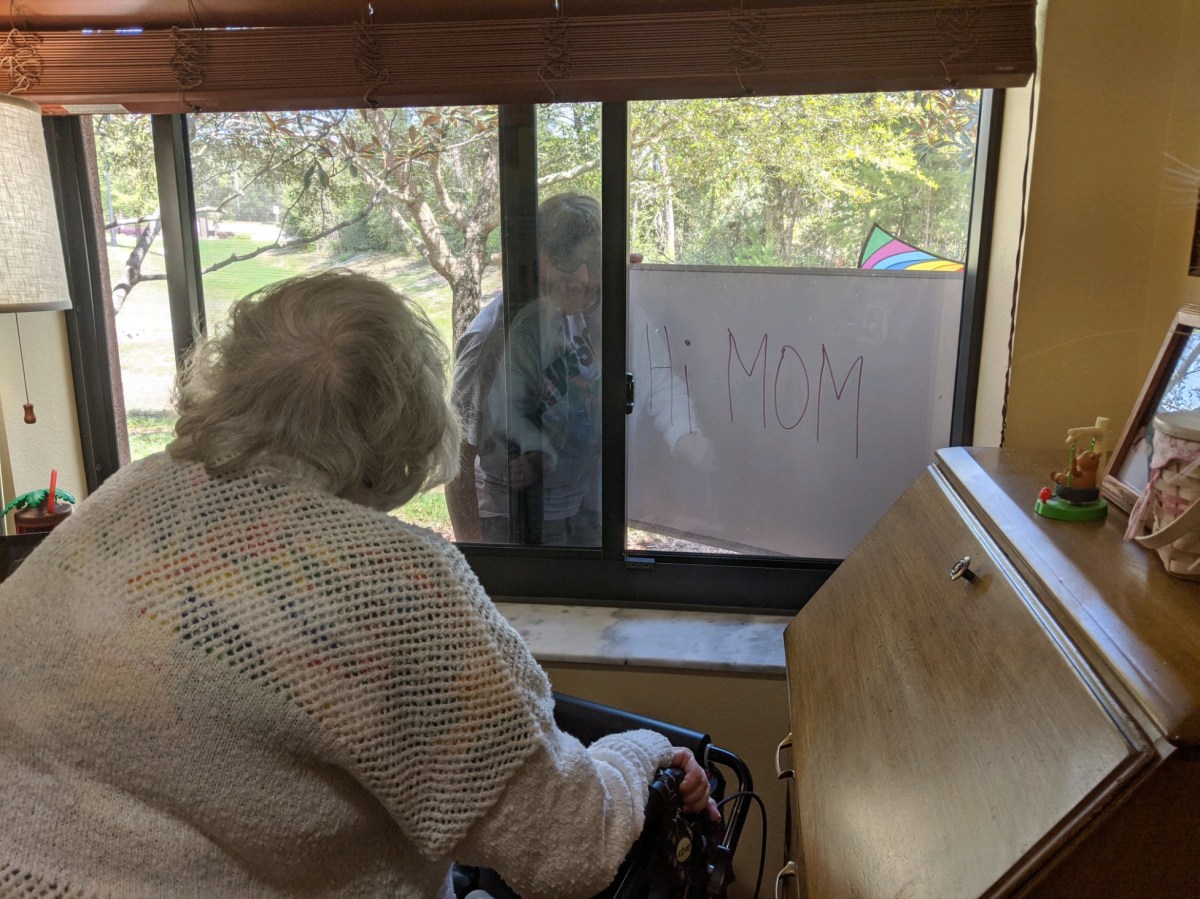
I knew that I couldn’t go inside the building, but wondered what would happen if I stood outside her window while she sat inside near the window? In that instant, ‘window visiting’ was born. 

The first time I visited and knocked on her window, she was intrigued and very surprised. I brought a large whiteboard, marker, and eraser with me. She motioned as if to ask, ‘what was I doing standing in the dirt in between the shrubs?’ 

I pressed on. I stood as close to the window as I could and started writing news of the day in huge letters on the board – one word at a time. One sentence, even in its most condensed and basic form, can take 5 minutes for her to understand. But she likes it and she feels connected so I have to do it. I draw stick figures and smiley faces and try to use hand gestures as well. I am lucky that she has a first-floor window, but it wouldn’t have mattered. I would have thought of something else if that hadn’t worked. But it has worked, and it has made a difference. When she sees me knocking on her window, her mood changes because she knows I am her lifeline to the outside world. 

My mom hasn’t seen my 94-year-old father in more than two weeks. Previously, my father would take a fifteen-minute car ride from his independent apartment complex to the assisted living facility to visit.  But as the world came to an abrupt halt, so did all of his routines. His already small world shrank even further. Days now run together, he forgets to eat, is more lethargic and less active. The less he does, the less he wants to do, and sadness and despair have slowly crept in. Without some intervention, I know he will slip into the abyss. 

Two parents, separated by several miles and in two separate buildings and both getting depressed. It is a lot to take in. You don’t have to have the virus to die from its effects. 

My parents don’t have a lot of tech tools at their disposal, except for my father’s cell phone. In desperation, during one of my window visits, I pulled out my iPhone, and video dialed my father’s cell phone. By sheer accident, he answered, and he was as surprised to see my face as I was that we had a visual connection. Without a word, I turned the phone toward the window, and suddenly my parents could see each other. They started waving and smiling. And even though it was through the glass, they were happy. And now, I video dial my father during every window visit. For me, it was an extraordinary moment of creativity in action. 

There are many examples of people doing extraordinary things. Drive-by grandparent sightings, virtual birthday parties, fostering pets in need, and even musicians presenting concerts from their own home living rooms. It may not look exactly like we are used to, but it does show that imagination and creativity can solve hard problems. 

Collectively, we all seem to have coronavirus fatigue. The news is filled with it, all conversations start with it, and we are hunkered down in our homes because of it. There are dented dreams, lost jobs, and canceled events. The end of this reign of terror is certainly a big question. But in the meantime, we can still look for solutions even when they aren’t always obvious. It may not be a cure, but it’s a start that might make a difference.

With Coronavirus, Seniority Stinks

The Coronavirus is kicking everyone’s butt. Of course, the concerns are not all health related. Yes, the highly touted medical experts on all the news shows speak at length about flattening the curve, sheltering in place, hand washing and sanitizing everything. It isn’t something to be taken lightly.

Beyond that are the emotional aspects of everyone putting their life on hold. Many younger people are very capable of keeping themselves busy inside their homes. But the elderly aren’t always that lucky. Many in nursing homes, assisted living centers, memory care units, and independent living apartment complexes depend on others to help them get through the day. They depend on others for stimulation, socialization and companionship. With this 
Coronavirus sweeping everywhere, it is hard for them to get what they need. Family and friends cannot visit, routines are disrupted and depression sets in.

That pretty much sums up my parents. They live relatively close to me, one in assisted living and one in independent living. They have been married for 69 years, and although they don’t live together right now, they still depend on each other. Before Coronavirus restrictions, my father visited my mother for a few hours every day. It was their routine. Now they are relegated to trying to talk to each other on the phone.

 At age 94 and 96, respectively, things are tougher now. My mom’s eyesight isn’t what it used to be, and she is excruciatingly hard of hearing. Both my parents use walkers and are slow on the uptake. Their world revolves around the bathroom and mealtime. They don’t have dementia per se, but this Coronavirus is making it difficult for them to understand why I can’t visit. Like the rest of us, they want to know how long the misery will last.

My father watches way too much news and wonders if medical triage and rationing will eventually extend to him. He tries not to be afraid, but his world is collapsing every day. He watches reports of hoarder’s panic-buying toilet paper and hand sanitizer and wonders if there will be any left when I go shopping for him. New rules state he cannot congregate with others. He can’t go to his favorite sing-alongs once a week. He has to eat meals alone in his apartment and he seems to be sleepier than usual. He calls me often about petty things and gets testy and impatient about others. “Why does the housekeeping lady have to turn the air conditioning on every time she comes to clean?” he asks, “why isn’t the wound on my leg healing? Is my shower lady going to be able to come to help me?” All questions I repeatedly try to answer in lengthy conversations.

I visit my mom by standing outside the first-floor window of her room at the assisted living facility and wave to her amidst the glare of the glass. We talk on the phone during these “visits” and try to act like this is normal. It does help to keep her grounded and connected, but she only understands a few words that I say despite having hearing aids in place.

I know the world is in crisis right now, and we have to be creative to stay connected, remain calm, and continue to live our lives. Thank goodness for the tech age in helping to keep in touch. I wish I could use it with my parents. They don’t Facetime, text, or email so it is mostly useless to me.

My parents have been through a lot in their lifetimes but nothing like this. The golden years are supposed to be golden, not a litany of one depressing thing after another. While it is hard for them to experience, it is harder to watch. And so, despite all the dire warnings and unsettling news, it is my job to prevent my parents from going off the edge. I do it without much thought because it is the right thing to do. I, like everyone else, hope this virus can be contained and eradicated so we can get back to some kind of normal.